
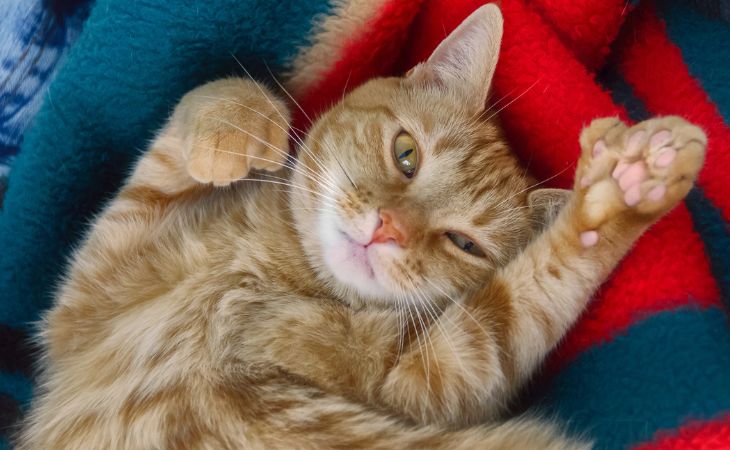
Polydactyly is one of the most common hand deformities in humans. It can also occur in some domestic animals, such as cats. This condition affects certain cat breeds more than others. Does your cat have six toes? There’s no reason to panic! Contrary to popular belief, this abnormality is harmless. In this article, we’ll tell you everything you need to know about polydactyl cats.
Polydactyly in cats
Polydactyly is a malformation characterized by an abnormally high number of toes. It primarily affects the cat’s front paws. In rare cases, the abnormality can also occur on the hind paws.
More specifically, a cat normally has four toes on its hind paws and five on its front paws. In cases of polydactyly, the cat may have six or seven toes per paw. The abnormality is generally symmetrical. In other words, if one of the front paws has more than five toes, there is a very high probability that the other paw will have the same amount of toes. Nevertheless, it is very rare for polydactyly to be observed on all four paws of a cat.
What is the cause of this abnormality in cats?
Polydactyly is usually caused by a hereditary genetic mutation. It develops in the embryo and can be easily detected around the 20th day of gestation in cats. In this case, for a kitten to inherit this abnormality, it is sufficient for one of the parents to carry the responsible gene. It is an autosomal dominant gene with variable expression.
Polydactyly can also be the result of certain genetic disorders. This is a very rare and quite serious condition. It can be a manifestation of feline radial hypoplasia or Ellis-van Creveld syndrome (EVC). These various genetic problems can also lead to skeletal and dental malformations, and potentially difficulties with movement or eating.
What are the different forms of polydactyly in cats?
There are two main forms of polydactyly in cats, postaxial polydactyly and preaxial polydactyly.
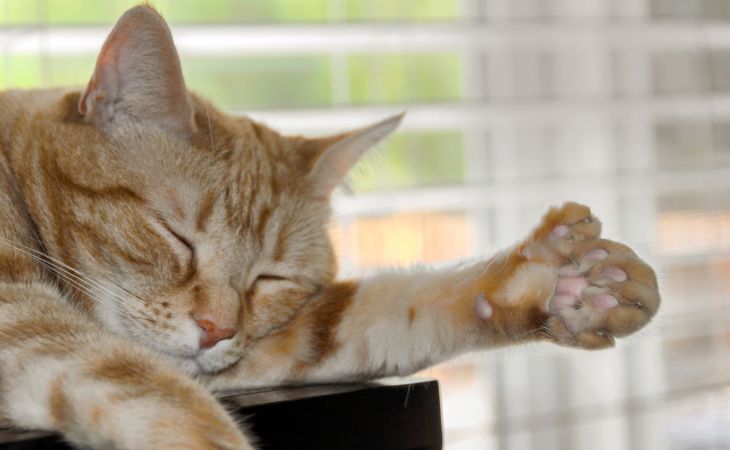
Postaxial polydactyly refers to the abnormality affecting the smallest toe of the paw. Nicknamed “hamburger paws,” this form is the rarest. In most cases, the extra toe is not fully formed. Preaxial polydactyly, on the other hand, is characterized by the presence of an extra toe on the big toe. Known as “mitten paws,” it is the most common form in felines.
In both cases, the extra fingers have their own pad. They also generally have plantar and palmar pads.
Which cat breeds are prone to polydactyly?
Polydactyly can occur in all cat breeds. However, some breeds have a genetic predisposition to this abnormality, such as Pixie-Bobs, Maine Coons, and in some cases, Owyhee Bobs.
Maine Coons, one of the breeds most affected by polyactyly
The Maine Coon is a breed that origined in the United States, more precisely in the in the far north of Maine. This region is situated in the north of the county and borders Canada. That is why it experiences fairly harsh winters with heavy snowfall.
The Maine Coon is particularly prone to polydactyly, affecting 40% of the population. This is due to the harsh living conditions in this snowy region. This characteristic allowed the Shag cat population, the ancestors of the Maine Coon, to better protect themselves from the cold with their wider paws. Today, only 2% of this breed of cat are affected by this malformation. The Maine Coon remains one of the breeds most susceptible to polydactyly.
The Owyhee Bob and Pixie-Bob
The Owyhee Bob is a breed resulting from a cross between the Manx and the Siamese. This is why it closely resembles the Siamese and has a very short or almost nonexistent tail, like the Manx. This breed is very often polydactyl. However, due to its rarity, it is difficult to know precise and reliable figures on the exact percentage of individuals affected.
The Pixie-bob is a relatively recent cat breed. One of the founding cats of this breed was polydactyl. This is why almost 50% of cats of this breed have this abnormality. It is also the only breed that is not disqualified from cat shows because of polydactyly.
Is polydactyly a disabling abnormality?
A few decades ago, polydactyly was wrongly considered an abnormality that could be harmful to cats’ health. During this period, according to popular belief, cats that had this abnormality were clumsy. It was said that these cats were not capable of hunting correctly, which could put their life in danger. For others, this malformation indicated that the cat was weak and had fragile health compared to “normal” cats.
Many scientific studies have demonstrated that polydactyly is actually harmless. It is a physical abnormality that in no way reduces a cat’s lifespan. In addition, it is not a disease, and therefore causes no discomfort to cats. However, it may slightly delay kittens learning to climb and walk.
Polydactyly can even be a benefit in some cases. The majority of cats with preaxial polydactyly (mitten-shaped paws) have greater dexterity compared to other felines. This abnormality can give them better balance, making them more capable of climbing taller trees.
Health risks associated with polydactyl cats
While polydactyly can be a benefit in some cases, it can also cause health problems in cats. Here are some of the risks faced by polydactyl cats:
- ingrown claws,
- risks of malformation,
- fractures,
- radial hypoplasia.
The position of the toes of some polydactyl cats can lead to ingrown claws. If the claw is not properly trimmed, it can lead to a more serious infection.
Additionally, the risk of fracture is high when extra toes grow on top of another toe. This is because they are not directly attached to the rest of the paw. In such cases, the extra toes are often much more fragile than the others. Although this does not cause any disability for the cat, the extra toe is more prone to fracture than the others.
Feline radial hypoplasia is a genetic condition characterized by the growth of extra toes on the animal’s paws. In this condition, these extra toes typically grow between the normal ones. Kittens born to parents with this condition may have severe paw deformities. Feline radial hypoplasia can be severely debilitating for the next generation, with detrimental effects on these cats’ lives. This condition is commonly referred to as “twisty cat.”
The best way to diagnose feline radial hypoplasia associated with polydactyly caused by a genetic mutation is to consult a vet. The vet will examine the cat by feeling its paws. They may also take an X-ray if necessary and ask the cat’s owners a few questions.
While polydactyly is not caused by a genetic mutation, it is usually accompanied by certain symptoms, such as misaligned teeth or shorter-than-normal paws. This is what should normally alert the owners of a polydactyl cat.