
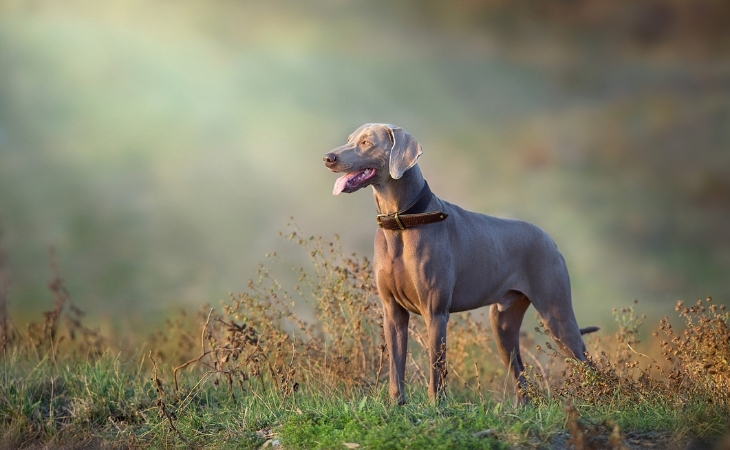
Breed: Weimaraner | Size: Large | Average lifespan: 11+ years | Character: Gentle, protective, and affectionate | Coat: Short | Origin: Germany.
The Weimaraner is an excellent hunting dog and a perfect family companion. It as an eye-catching coat color and proud demeanor.
The origins of the Weimaraner
Unclear origins
Although the breed’s name points to Germany, the origins of this hunting dog are still a subject of debate. This breed’s ancestors may have originated in Palestine; they are thought to have been grey griffons brought to France by King Louis IX following his imprisonment there during the 13th century. These dogs were subsequently crossed with various other breeds, such as the Bloodhound and Arabian sighthounds, to enhance their hunting qualities.
Their descendants found their way into royal packs, and several hunting enthusiasts among the nobility used and popularized them across Europe. Notable among them was Jean de Béthencourt, who commissioned two statues of these dogs to adorn the forecourt of Las Palmas Cathedral. The breed remained highly prized by noble hunters for several centuries, and they were used primarily for hunting wolves and wild boar.
This breed appeared in 18th-century Germany, specifically at the court of Grand Duke Carl August of Saxe-Weimar. The breed’s numbers grew, and the dogs were found in the company of many hunters who were courtiers of the Duke. The Duke himself refined the breed and gave it its definitive name.
The character of the Weimaraner
The Weimaraner has an impressive silhouette, stunning coat color, and affectionate character. This breed has it all!
A born hunter
The Weimarener is a hunter at heart, and this shapes its temperament. It loves covering miles in the woods with its owner. This breed actually needs and enjoys this kind of exercise. It generally loves to work and struggles with inactivity. This dog can adapt to any activity, from playing with children to agility training. Thanks to its keen sense of smell and courage, it makes a natural and excellent companion for hunters.
Additionally, the Weimaraner is a gentle dog that loves to please its owner. They are also full of cheer and know how to have fun. This breed is very alert and protective, yet by no means aggressive. These dogs are devoted to their owners and would do anything for them.
It is very sociable and affectionate. After an afternoon of walking, it enjoys cuddling for a long while.
The long-haired variety, which appeared in the 20th century, is recognized as being calmer, even though the Weimaraner is generally known for its patience.
A proud dog breed
This dog breed is dignified, and it knows it! In fact, the Weimaraner can be particularly haughty. It’s as if they know they were once a dog of royalty and won’t hesitate to remind you! In addition, this breed is very stubborn!
Through appropriate training, it is important to show these dogs from a very young age that you are the boss. Otherwise, he will try to become the pack leader himself, as this breed tends to be dominant.
This dog needs to be active. This is very important to know before succumbing to its charm. This breed won’t thrive if you spend your days in front of the television.
This breed is an excellent watchdog, he will bark if he sees a stranger and can be very wary. Weimaraners are generally dominant with other dogs and can be dangerous toward small pets, which they may mistake for prey.
The physical characteristics of the Weimaraner
Two types
There are two types of Weimaraner dogs. The best known and oldest type is the short-haired Weimaraner. It remains the quintessential representation of the breed and is the most popular. The other type has long hair. This type emerged during the 20th century, but is still relatively rare.
General
The Weimaraner can be recognized by its distinctive coat color. It is also a fairly large dog. At first glance, people notice this breed’s elegance and power.
Head
This breed’s head is straight and rather broad. However, the head is less broad in females. The stop is barely noticeable. When it comes to the muzzle, it is long with a black nose. Two long ears frame the head and are set high.
At birth, the eyes are blue and then they turn amber. They are round and slightly slanted.
Body
The Weimar has a long, powerful body. Its limbs are straight and show great strength. The chest is also powerful. In short, it has the body of a true athlete. Its tail is carried low and may be docked.
Coat, colors, and care
Coat
Depending on the type, the coat can be different:
- The most common coat type for the Weimaraner is short, dense, and fairly fine;
- It can also be long. However, the length of the hair remains reasonable.
Colors
Whether the coat is long or short, the color is the same. It is a grayish beige that gives it a beautiful silvery appearance. Several shades are acceptable: mouse gray, silver gray, or even dark gray that resembles blue. The coat must be particularly glossy.
Caring for a Weimaraner
These dogs don’t require special grooming. For short-haired dogs, occasional brushing is enough. Long-haired dogs should be brushed once a week. That’s it!
However, you’ll need to remember to clean this breed’s ears from time to time. If your dog hunts, also be sure to check the paw pads and the insides of his ears to make sure there are no foreign objects.
A bath isn’t necessary, unless, of course, your pet has been wallowing in the mud. Other than that, since their fur tends to clean itself, there’s no need to give your dog a bath.
Did you know?
The elegance of this breed has made it a model for numerous advertisements. The dog breed has appeared, for instance, in ads for Chanel’s Coco perfume and the Jaguar F-Pace SUV, showcasing the breed’s taste for luxury.
The Weimaraner at a glance
Size: Females are typically 59 to 64 cm. Males are typically 60 to 70 cm.
Weight: Females weigh between 25 and 35 kg (≈ 55.1 and 77.2 lb); males weigh between 30 and 38 kg (≈ 66.1 and 83.7 lb).
Health: The Weimaraner is a relatively healthy dog. However, this breed can gain weight if it doesn’t get enough exercise. After all, it does have a big appetite! You’ll need to do your best to keep its weight stable to avoid heart or joint issues. The breed can also be prone to stomach torsion if it eats too quickly or gets excited after meals. Although it’s becoming increasingly rare, the breed is prone to dysplasia.
Average lifespan: around 11 years.
Is the Weimaraner good with children? This dog loves playing with children. However, it’s important to make sure the dog is well-trained so it doesn’t become too dominant. These dogs can, in fact, turn into tyrannical playmates if children annoy it.
Is the Weimaraner easy to train? Training a Weimaraner must be done with care to have a well-balanced dog. You need to be firm to ensure the dog responds effectively. Positive reinforcement is used to achieve the best results. There’s no need to use force. Socialization should also begin at a very young age so the dog feels comfortable in its own skin. This is the only way to ensure it is friendly toward strangers, whether they have two or four legs.