
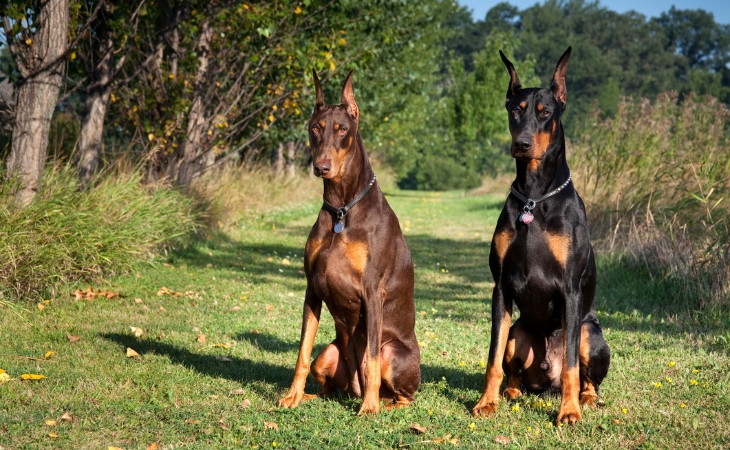
Breed: Dobermann | Size: Large | Average lifespan: 10+ years | Character: Loyal, attentive, and affectionate | Coat: Short | Origin: Germany.
The Dobermann, also known as the Doberman Pinscher in North America, is a strong, elegant, and big dog. It is also intelligent and full of energy. This dog breed is an excellent companion and a great guardian for owners and their families.
The origins of the Dobermann
A breed originally from Germany
First bred in 1860, the Dobermann resulted from several crossbreeds. It owes its name to its first breeder, Karl Friedrich Louis Dobermann. In the late 19th century, this German tax collector wanted to create a reliable, personal guard dog that would help him deter thieves. As Karl was also the director of a local animal shelter, he carried out complex crossbreeding experiments to develop the perfect dog for his project. His goal was to create a physically imposing and fierce breed known for its bite and courage.
A crossbreed of several dog breeds
The story goes that this German tax collector crossbred Great Danes and Rottweilers for their strength and size. For speed, he chose to crossbreed Greyhounds as well. In addition, Karl used Manchester Terriers for their slender build, smooth coat, and tenacity.
Other dog breeds were also used in the development of this dog:
- the Schnauzer,
- the German Shepherd,
- the Pinscher,
- the Weimar Pointer,
- the German Wirehaired Pointer.
Although the early days of this breed were not very promising, the Dobermann is now seen as an impressive breed that is highly regarded around the world. The Dobermann breeder devoted nearly 60 years of his life to creating the perfect dog for personal protection.
The first Dobermann was registered in the German stud book in 1893. Six years later, the breed was recognized by the German kennel club (VDH). Thanks to its undeniable abilities, it has become very popular around the world. Unfortunately, its qualities as a guard dog have gradually diminished over the years. Today, the Dobermann is considered a companion dog, but it retains its protective instincts. The breed was recognized by the FCI (Fédération Cynologique Internationale) in 1955.
The character of the Dobermann
Even though the Dobermann has an imposing appearance, it is an affectionate dog breed.
The qualities of the Dobermann
This dog breed is loyal and devoted to its owner. They are also highly attentive, striving to please their owners and would not hesitate to defend them. However, it’s important to keep in mind that this dog needs mental and physical stimulation. To prevent your dog from getting bored, you should train them as often as possible so that they do not develop behavioral problems.
In addition, the Dobermann has a strong and dominant personality, especially toward other dogs (particularly those of the same sex). However, if you socialize it with other pets and children from a young age, it can make a very good family dog. Since this dog doesn’t really like being teased, you’ll need to teach children how to behave around it. Keep in mind that you are responsible for your pet’s behavior.
Are there any downsides to having a Dobermann?
This breed does not like being alone at all. For example, the Dobermann can become destructive if its needs are not met or if it is left alone for an entire day. Moreover, it is very wary of strangers and may react aggressively when faced with danger. It is not the kind of dog that lives outdoors. It is an excellent guard dog that must be socialized early and trained firmly.
The Dobermann’s physical characteristics
General
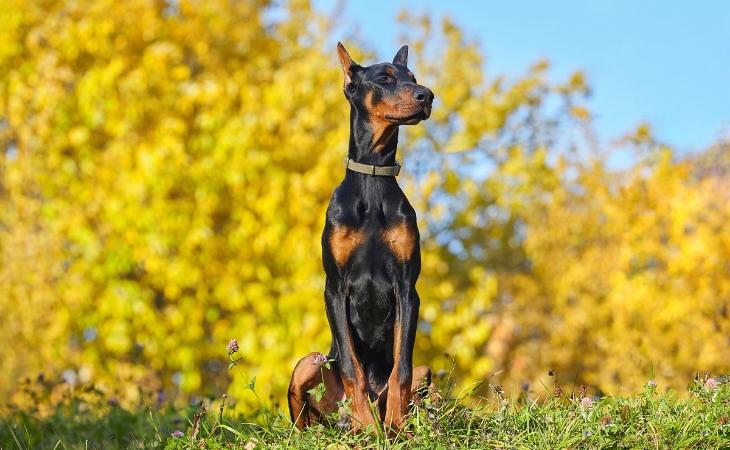
This dog can weigh up to 45 kg (≈ 99.2 lb) depending on its sex and measure up to 72 cm at the withers. It’s an elegant dog with a well-defined muzzle from a very young age. Once they are fully grown, it is recognizable by its erect ears (often due to ear cropping) or drooping ears, and its short, high-set tail. If the tail is docked, two vertebrae are left intact.
Did you know? In France, for example, ear cropping in dogs is strictly prohibited, except for medical reasons (Decree No. 2009-1768 of December 30, 2009, Art. R. 214-21).
Head
The Dobermann has an elongated head, a strong skull with well-developed muscles, and brow ridges. The ears of this breed are set high and stand erect if cropped. Otherwise, they hang down. Its eyes are oval-shaped, light or dark in color depending on the type, and of medium size.
Body
In general, this guard dog has a distinctly prominent withers and a long, muscular loin. Its back is short and muscular, its belly is tucked up, and its chest is well-developed.
Coat, colors, and care
Coat
When it comes to the coat, it’s a dense, short, smooth, close-lying coat with a coarse texture. This breed has no undercoat, which gives it an elegant appearance.
Colors
The Dobermann breed is black or brown with tan markings. The tan markings are located specifically on the muzzle, chest, throat, legs, cheeks, eyes, around the anus, and on the inner thighs.
A few years ago, these dogs were also found in a blue-and-tan variety. However, these dogs had inherent genetic defects and were removed from the breeding program.
Caring for a Dobermann
This dog breed sheds very little. Since it has short hair and no undercoat, grooming is also fairly easy. With that being said, the Dobermann should be brushed regularly to maintain the coat’s shine and keep it clean.
Experts recommend brushing this dog breed at least once a week. After walks, clean the coat with a rubber glove to remove debris and loose hair. This dog does not need frequent baths. However, its teeth and eyes should be cared for regularly. For example, the ears should be cleaned with cotton and a suitable, pH-balanced solution.
Did you know this about the Dobermann?
The Dobermann appears in the 2009 film Up, directed by Pete Docter and Bob Peterson. In the film, this dog was owned by Charles Muntz and he was the mastermind of the trio of dogs tasked with capturing the bird Kevin.
The Dobermann at a glance
Size: Male Dobermanns measure between 68 and 72 cm, and females between 61 and 68 cm.
Weight: Males are between 40 and 45 kg (≈ 88.2 and 99.2 lb) and females are 32 to 35 kg (≈ 70.5 to 77.2 lb).
Health: Overall, this breed is a hardy and robust. Although this dog can tolerate heat well, it is more vulnerable during cold seasons and heat waves. This dog is also prone to hereditary conditions and heart disease as it ages.
Average lifespan: 10 to 12 years.
Is the Dobermann good with children? Yes, as long as you socialize them from the beginning. You also need to teach children not to tease them or hurt them, especially when they are resting quietly.
Is the Dobermann easy to train? Young Dobermanns are sensitive, intelligent, and affectionate. They need to be trained at a young age so they can socialize and bond with other family members, as well as your friends.