
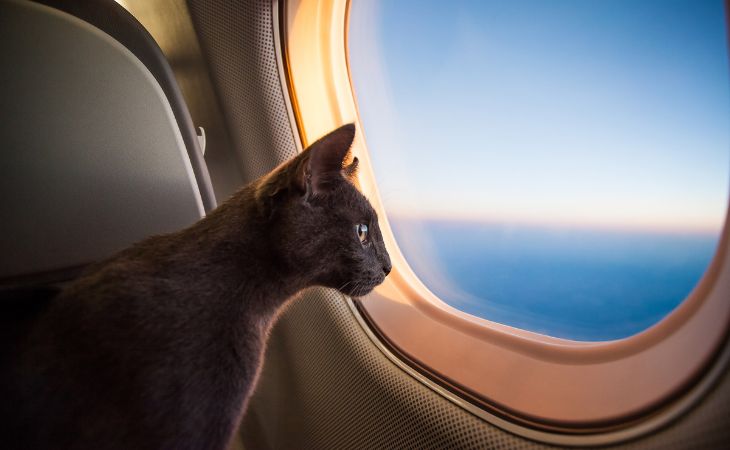
When it comes to long trips with a cat, traveling can be complex. In this article, we will go over legal requirements for cats on planes, how to choose an airline, plane tickets, equipment, and recommendations to help you travel by plane with ease.
Traveling with a cat by plane: the legal requirements to follow
Humans can’t board flights without complying with certain legal requirements, and the same applies to cats. There are several mandatory formalities required for pets when they travel by plane. The following requirements apply to Europe: your cat must be up-to-date with their vaccines, they need to be microchipped, and they must also have a European pet passport issued by a licensed vet.
Besides the rabies vaccination, certain vaccines are mandatory for specific destinations. For example, the distemper and leptospirosis vaccines are required by Norway. In addition, when traveling to Australia, your cat must be vaccinated against parvovirus, infectious canine hepatitis (infectious feline herpesvirus), and distemper. When traveling to New Caledonia, your cat must be vaccinated against feline panleukopenia (feline distemper), calicivirus, feline herpesvirus (feline rhinotracheitis), as well as the vaccines mentioned above.
Additionally, when traveling to another country, you should inquire about the requirements and formalities for your pet upon arrival. It is advisable to contact the embassy of your destination country to obtain the appropriate information.
If you have a Persian cat, it is highly likely that they will be prohibited from traveling by plane. That is because the breed is prone to respiratory issues.
How do you choose an airline?
It’s important to note that not all airlines allow pets on board. Additionally, airlines that do allow cats have their own specific requirements. For example, your cat might be allowed in the cabin with one airline, while another will require it to travel in the hold, regardless of the weight.
To be allowed to stay in the hold, your cat must not weigh more than 8 kg (≈ 17.6 lb), including the carrier. For flights within mainland France, airlines generally accept cats that are at least 10 weeks old and have up-to-date vaccinations. If you are traveling to French Guiana, on the other hand, your cat must be at least 15 weeks old. However, if your pet is only 8 weeks old, you can travel freely with them to Guadeloupe, Martinique, or Reunion.
In addition, it is recommended to contact the airline well in advance. For instance, you can contact their customer service and obtain all the necessary information you need to travel with your cat by plane. After booking your flight, it is also best to call the airline 72 hours before departure to confirm that your cat will be present on the plane.
Your cat’s plane ticket and choosing good transport equipment
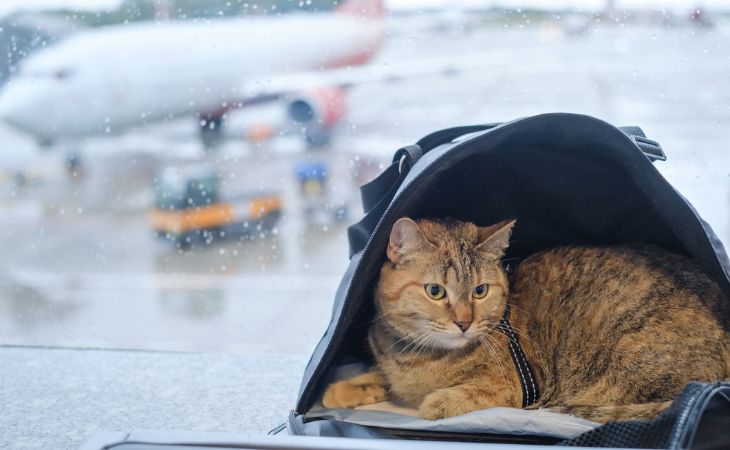
You can book your cat’s plane ticket online just like your own. However, be aware that the ticket price may vary depending on your travel route. Unfortunately, there is no standard fare. Whether you want your pet to travel in the cabin or in the hold will also affect the ticket price. Additional fees may apply depending on various factors. However, prices generally range around €20 to over €100. For example, for flights within mainland France, an average price of €30 is often charged.
For France, the carrier or crate required must be well-ventilated and spacious. The crate must measure 46 × 28 × 24 cm. This size is required because it allows your cat to turn around easily and be comfortable, whether they are standing or sitting. Rigid carriers are not allowed, regardless of their dimensions. This measure is recommended for safety reasons.
If your flight is long, it’s recommended to line the bottom of your cat’s carrier with absorbent material. You can additionally affix a “Live Animal” label to the carrier. Inside the clear plastic wrap covering the carrier, place your cat’s important information and documents, such as your contact details, health and vaccination records, etc. You can also place a food and water bowl inside. A few of your cat’s favorite toys will help them feel comfortable during the flight.
Some recommendations for before, during and after your cat’s flight
Motion sickness, which is common in humans, also affects pets. It manifests itself in various ways in pets. For example, in cats, motion sickness can lead to behavioral problems. Your cat may become stressed, anxious, or very agitated in the carrier.
Before your cat departs by plane
If you’ve never traveled with your cat in any form of transport before, start by allowing your cat to get used to a carrier. Put them in the carrier at home for a while. Then, take them on public transport (bus, subway, or train) for short trips.
To avoid any discomfort associated with travel, you should never give your pet tranquilizers during a flight. These types of medications can produce undesirable side effects in animals during flight.
During the flight
There are several products you can use to calm your pet during a flight. Pheromone sprays are very effective in ensuring your cat’s well-being throughout the journey.
Additionally, you can use Bach flower remedies to soothe cats. You can also use homeopathic granules made from a blend of Bach flower remedies for your cat. It’s best to consult your vet or a pharmacist to know what is best suited for your pet, especially if your pet has a specific health problem.
After the flight
When you arrive at your destination country, you must go through customs. While some countries may not inspect pets, it’s recommended that you have your cat’s passport and health certificate readily available just in case.
Keep in mind that your cat may be unsteady on their feet once you arrive at your destination. It’s best to let your cat rest and avoid strenuous physical activity. If your cat’s unsteadiness persists, consult a vet or call your own i possible.
Why is it important to comply with air travel regulations for cats?
When your pet’s paperwork is not in order, your cat can be quarantined upon arrival in your host country or returned to your country of origin. In some cases, a quarantine is required by the authorities of your destination country. In addition, if the animal is suspected of having a serious illness or poses a significant potential danger to your host country, the pet may be euthanized.
It’s really important to properly prepare for your trip with your pet, as the laws and regulations in some countries are very strict and must be obeyed. Being in compliance also prevents you from wasting time and spending more than necessary when on your trip. Any additional costs incurred due to non-compliance will be your responsibility.
Furthermore, keeping your cat’s vaccination record up to date also ensures your safety. If there is an endemic disease in your host country, your pet won’t contract it. In addition, upon your return, you won’t be held up at the airport, especially by lengthy checks that would waste your time unnecessarily. You simply need to present your pet’s health record, issued by a licensed vet, for a smooth and stress-free journey.
Source: https://fr.statista.com/themes/3183/les-francais-et-les-animaux-de-compagnie/